
Kalamazoo County Busted Booking Records
A booking is what an agency writes down when someone is arrested or turns themselves in. The event gets recorded, not the outcome. In Kalamazoo County, that paper trail splits fast. The Sheriff's Office runs the Jail Division and the county jail. The Kalamazoo Department of Public Safety or the Portage Department of Public Safety may hold the original incident report. One arrest can live in several filing cabinets at once.
Know which cabinet holds what. The jail keeps intake and custody details. The arresting department keeps its own report on the stop itself. The courthouse keeps whatever case gets filed after that. For anyone hunting Kalamazoo County busted booking records, the county portal is the doorway. It names who was booked and when. It works as an index, though, not a photo gallery.
Important: A booking row, listed charge, or booking-photo request shows an arrest entry only. Check the court file for the outcome of the case.
Kalamazoo County Booking Record Fields
Start with the official KCSO Inmate Inquiry search. Its public view is fairly bare, yet it gives you enough to tell records apart. A name alone can mislead when the same person appears in multiple bookings. Grab the booking number or subject number instead. Treat the fields you see as a snapshot of county custody, not the whole story of what happened.
| Field | What it shows |
|---|---|
| Name | The identity displayed by the county system. Confirm spelling and other identifiers. |
| Subject number | A county identifier that helps separate similar names. |
| Booking number | The best public identifier for a specific intake event when shown. |
| In Custody | Status shown by KCSO when checked. A negative result can follow release or transfer. |
| Multiple bookings | A warning that the person can have more than one record. |
| Housing facility | The facility field displayed with the relevant county entry. |
The roster shows no photo column, no thumbnail, nothing to click for an image. That silence is limited, though. A booking photo may still exist in the file. The public search simply does not display it. For a specific image, ask the Sheriff directly with a narrow request. Certain exemptions can still block release of an individual record.
Request Kalamazoo County Booking Photos
When the portal comes up empty, the county's FOIA process is the official route. Route a jail-intake request through the Sheriff's Office records channel. Michigan FOIA lets the agency redact what is exempt and hand over the rest. The agency can also ask you to clarify a request that is too vague or would force it to build something new from scratch.
- Identify the person, approximate booking date, arresting agency, and booking or subject number if known.
- Ask for the existing booking record and any releasable booking photograph, rather than a broad list of names or images.
- Use the county portal, email, fax, mail, or in-person route described by the county procedure.
- Request a digital copy where available and a written fee estimate before work above the county threshold.
- Ask for the legal basis for any withholding or redaction, then compare the record with the court file.
Fees work by category here. Kalamazoo County publishes no flat booking-photo price. Instead, labor, copying, mailing, and digital-media costs can apply, and a deposit may be demanded once an estimate tops $50. Expect a reply within five business days, with a possible ten-day extension. Public-interest and indigency options exist too. Keep the ask narrow rather than guessing at a total nobody has quoted.
Note: The Sheriff holds jail intake material, while the originating police department can hold a separate arrest report or case photograph.
Michigan Busted Mugshot Record Law
Michigan has no single statute granting blanket publication rights over booking photos. There is no statewide pay-to-remove ban either. The governing framework is the Michigan FOIA, MCL 15.231 et seq., along with the exemptions spelled out in MCL 15.243. Privacy, open investigations, fair-trial concerns, confidential sources, safety, custody, and victim details can all shape what gets released. The question worth asking is narrow: is this record releasable from this agency?
Biometric and arrest-record rules under MCL 28.243, plus Michigan's set-aside process, can matter after a dismissal or other qualifying court action. Send the agency an official disposition or order with any correction request. A publisher's copied page or a stale search result is a different problem entirely and needs its own correction or index-refresh request.
Private sites are a separate lane. Recently Booked, Mugshots.com, and Busted Newspaper all describe maintenance or removal routes for qualifying errors or favorable outcomes. None of them are county agencies. Their listings can run behind reality. Recently Booked waives fees for qualifying corrections. Mugshots.com describes free record maintenance. Busted Newspaper offers a removal form with no promised turnaround. No paid-removal service is endorsed anywhere here. Anyone demanding money or guaranteeing a result before you check the official record deserves your suspicion.
After a dismissal or set-aside, work in order. Keep the court order or docket reference handy. Ask the KCSO or the originating agency to correct its record first. Then contact the publisher with the exact page URL and your supporting document. Google and Bing outdated-content tools can refresh a search result once the source page is gone or changed. Neither will touch a page that is still live. That order keeps three things straight: fixing an official record, updating a copied entry, and refreshing an index.
Find Kalamazoo County Busted Records
Go county first. That is the dependable path for Kalamazoo County busted records, and it works no matter where the arrest occurred. Kalamazoo, Portage, and Galesburg each release information differently. Yet once an arrest turns into county custody, the jail roster becomes the shared public route. A result there might mean current custody, a lingering post-release entry, or one booking among several.
- Open the county inmate search and use a full name, booking number, subject number, or narrow date range.
- Check In Custody and housing facility, then record the date and time of the search.
- Use the arresting agency's release or records unit for the underlying report, not as a substitute for jail status.
- Check MiCOURT Case Search for later docket events and disposition.
- Use KCSO FOIA for missing booking fields or a photo, then use state or federal tools only for their distinct custody state.
Third-party listings have their place. They can surface a name or an older event quickly. But they lag, copy errors, miss later court results, and sometimes keep showing an old image long after release. When sources clash, the official roster and the court record win. A possible warrant calls for a different check altogether. Start with the Sheriff's Most Wanted page.
Where Kalamazoo County Mugshots Appear
Different channels answer different questions. Start with the official ones. A county custodian can tell you who is holding someone right now and which record rules apply. News stories and third-party sites offer context and historical leads, but they cannot confirm live custody. Treat them as background, never as a substitute for the county roster itself.
| Channel | Photo? | Status and access |
|---|---|---|
| KCSO Inmate Inquiry | No public photo field observed | Official booking and custody lookup by name, number, date, status, or housing. |
| KCSO FOIA | Ask for releasable image | Official request path for a defined booking record or photograph. |
| KDPS and Portage releases | Occasional non-booking images | Official, selected incident notices rather than complete booking feeds. |
| MDOC OTIS | Profile image where available | Official state supervision record, not a county booking record. |
| Local news | Story, agency, or scene images | Selected reporting, useful for context but not a jail record. |
| Aggregators | Often show images | Unofficial historical or current-looking listings. Verify with KCSO and the court. |
Searches for Kalamazoo County often surface Recently Booked, Busted Newspaper, Mugshots.com, and Arrests.org. A county entry can linger on those sites long after release. City labels do not always match county lines. Mugshots.zone, for its part, had no verified Kalamazoo County page. These publications work best as secondary leads to check against an official source rather than as the last word on anyone's status.
Kalamazoo County Busted Roster Search
The Sheriff's Office portal runs on a Tyler Technologies New World Inmate Inquiry interface. You can search by name, subject number, booking number, in-custody status, a booking date range, or housing facility. Grab a unique number whenever you have one. A surname paired with a tight booking window works well otherwise. For a current-custody question, pick the in-custody filter and then read the displayed field at the moment you look, since the answer changes as people come and go.
A typical result shows Name, In Custody, Race, Gender, Multiple Bookings, and Housing Facility. Pay attention to that Multiple Bookings flag. It warns that one person can appear in several rows, so count people, not entries. KCSO publishes no refresh schedule, no guaranteed posting delay, and no stated retention period for the web view.
Use the roster for four separate checks. Confirm the person. Confirm the booking number or date. Read the in-custody field as it stands right then. The fourth step, tracking what a court or another agency later does with the case, belongs to the next custodian down the line and cannot be guessed from a static row. The official KCSO result interface shows the field layout you will see during a live lookup. Match each row to its booking number and date before drawing any conclusion from it.
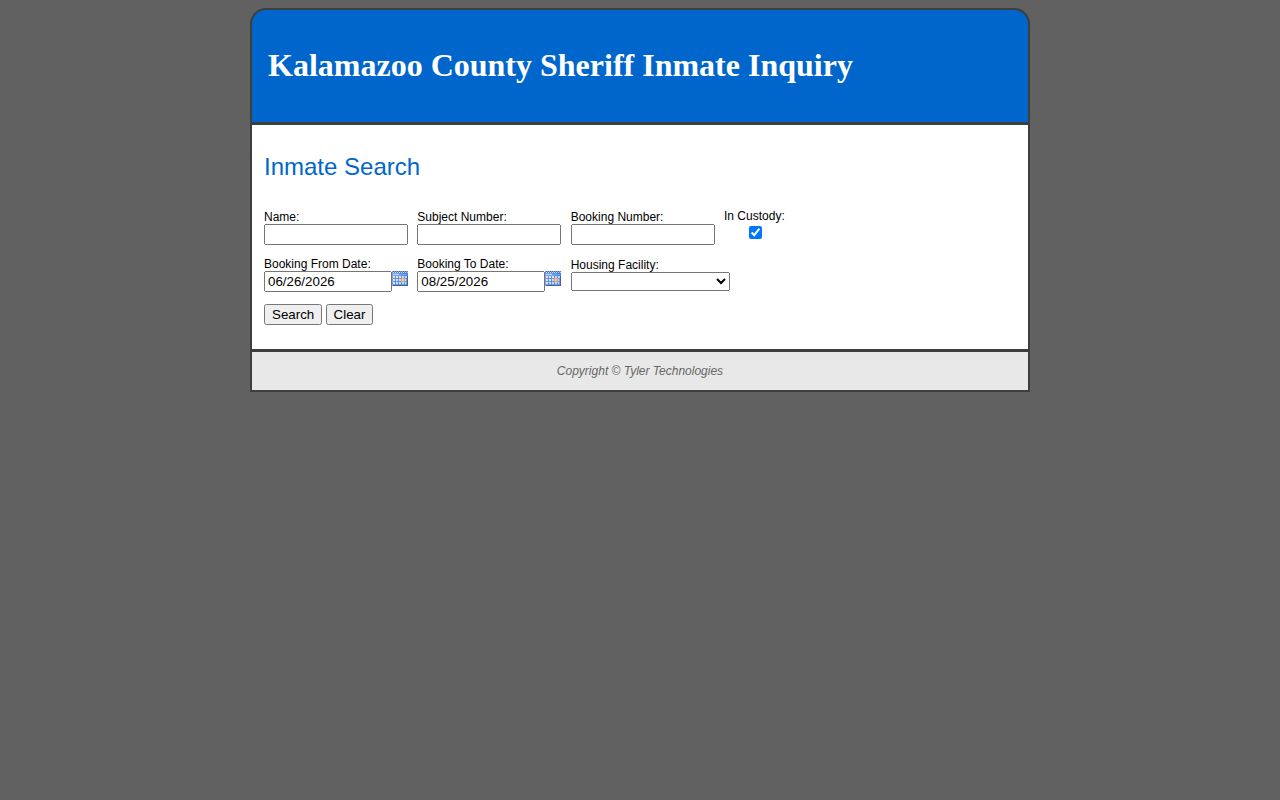
The result view makes clear why In Custody and Multiple Bookings each deserve their own attention. No public mugshot appears in it.
- Booking
- Jail intake after an arrest or surrender.
- Arraignment
- A court appearance where charges and rights are addressed.
- Bond
- A court-set condition that can affect release while a case is pending.
- Disposition
- The later court outcome, such as dismissal, plea, conviction, or another resolution.
Recent Kalamazoo County Busted Bookings
There is no page labeled today's bookings on the KCSO site. No 24-hour feed, no 72-hour blotter, no weekly arrest log. The official route for same-day or multi-day searches is the Booking From Date and Booking To Date fields. A 24- or 48-hour window pulls records entered in that stretch. Widen to three or seven days when the first pass comes up empty. In Custody limits results to the status shown when you check. An unfiltered date search can still return someone already released.
City sources add narrative. KDPS News Releases and Portage NewsFlash publish selected incident notices rather than complete booking archives. The county's Notify Me service offers Sheriff Alerts, News Flash, and News from the Sheriff by email or text. No new-bookings alert or booking-photo app exists there. Those notifications flag public-safety news. The live roster stays the county's custody check.
Older events call for other routes: KCSO FOIA, the arresting agency, the court, or an archive. Arrests.org lets you navigate by year, month, and day. Both Busted Newspaper and Mugshots.com carry historical-looking entries. None of these is a live county custody feed. Whatever you find there needs a source date and a later court status before it means much.
Note: A date-range query returns whatever the live county database holds, not a promise that every booking was posted instantly or stays online.
Kalamazoo County Court and MDOC Records
Adult criminal cases start in the 8th District Court. Misdemeanors stay there through sentencing. Felonies can move up to Circuit Court after a preliminary examination. That split explains why booking language and court language often differ for the same person. MiCOURT serves as a public informational starting point rather than the official court record. Contact the court directly when a docket is old, missing, protected, or incomplete.
Statewide, the Michigan Department of Corrections OTIS system covers qualifying prisoners, parolees, probationers, and recent discharges under MDOC supervision. It can display an official offender image where one exists. It does not include every county booking, a person released locally, or a city arrest that never becomes a state-prison case. Think of OTIS as state custody or supervision, not Kalamazoo County jail custody.
Federal custody runs on entirely separate tracks through BOP and ICE. Neither one substitutes for a KCSO booking record or the county's public photo field. People do move between systems. Pin down the agency and the custody state before trusting any single record.
Kalamazoo County Busted Record Limits
Plenty of matters never show up in a public search. Juvenile files, sealed files, restricted files, victim-related files, and investigation-sensitive files can all be protected. MiCOURT does not display every protected category either. So a name that comes back empty might reflect timing, a spelling variation, a different lodging location, a protected file, or a different custodian altogether. Absence is simply absence.
The county's Notify Me list covers Sheriff Alerts and News Flash subscriptions by email or SMS. Silent Operator-style tips go to Silent Observer, a separate channel. VINE and VINELink handle custody notifications. Each serves its own purpose. None of them promises a full booking list or a booking photo, and none replaces the roster's in-custody field.
Older Kalamazoo County Mugshot Records
How long do old Kalamazoo County booking files stick around? Michigan's General Schedule 11 gives jail inmate jackets, which can include photos, a ten-year retention after release. Booking and control-center logs get seven years past the calendar year in which they close. None of that guarantees anything online. The public Tyler portal may drop fields or photos well before the retention clock runs out. For a specific older file, it pays to ask KCSO which schedule governs it.
Deep research takes you to the Kalamazoo Public Library Local History collection and the Archives of Michigan county guide. That guide names the record groups worth requesting. Think historic booking records, jail records, mug-shot and fingerprint ledgers, and older photographs. A good request names the county, the record title, the date range, and the record group if you know it. Western Michigan University's Regional History Collections may hold partner material too.
Note: The library's local-history materials pair well with archived newspapers and other historical record searches.
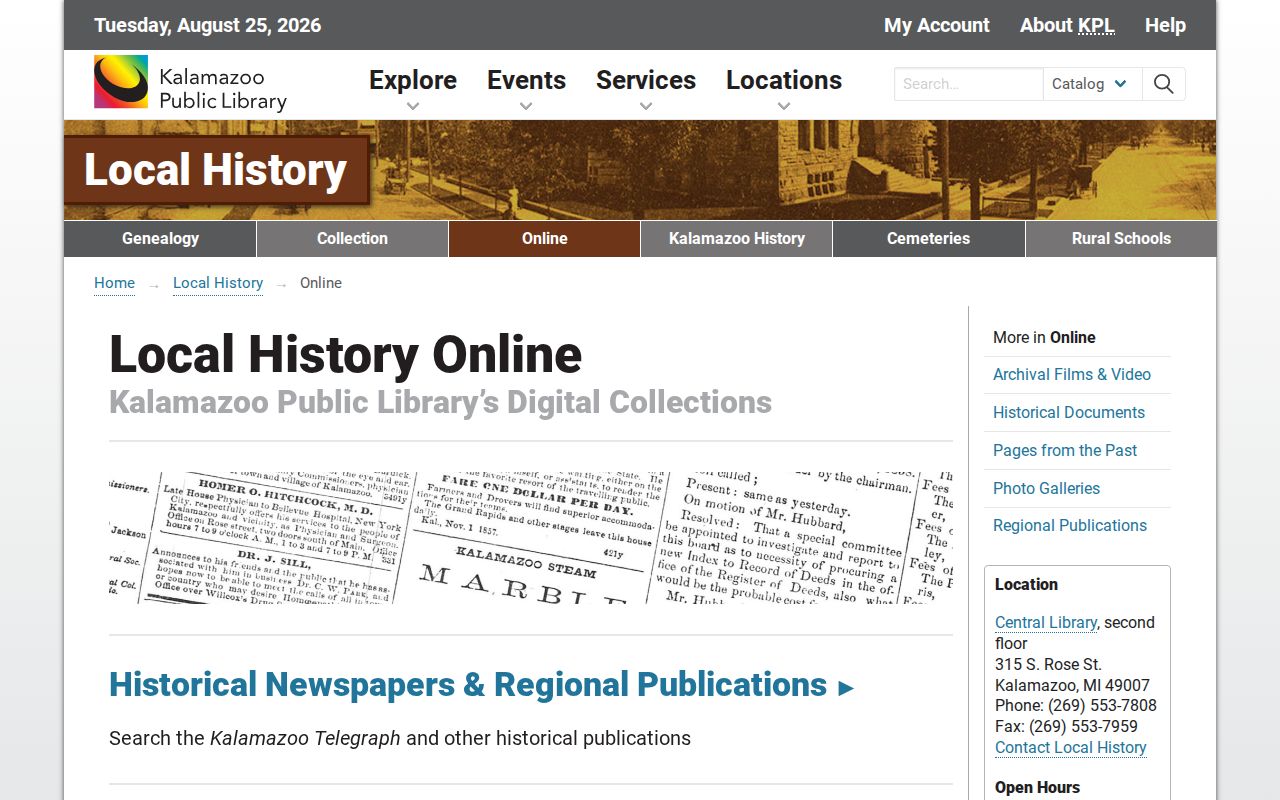
A historic ledger, a current county roster, and a court docket sit in different places and follow different rules. Write down the repository and the date range for each source you use. One modern search will never span every era of Kalamazoo County arrest records.
Say exactly what you want. A booking ledger, a fingerprint ledger, a mug-shot image, a court file, and newspaper context all live in different record groups. Ask whether the Archives of Michigan or a partner repository holds it. Ask whether it has been digitized, and what copying rules apply. Old indexes often use spellings that no longer match modern names. When a modern file never shows up online, a KCSO request can confirm whether it was retained, transferred, or destroyed under its schedule.
Busted Mugshots by Kalamazoo County City
Kalamazoo County's three largest cities each run their own police and records paths. The county jail still serves as the shared booking hub whenever an arrest leads to county lodging. Each city page here keeps that common roster route. It just separates city incident records from the jail's booking information.
- Kalamazoo Busted Mugshots: KDPS releases and Records Bureau, then the county roster for county lodging.
- Portage Busted Mugshots: Portage DPS records and NewsFlash, with KCSO as the lodging fallback.
- Galesburg Busted Mugshots: KCSO contract-policing and booking path, with City Hall FOIA for city-held material.
The map highlights Kalamazoo, Portage, and Galesburg based on population. It ranks nothing. It promises no equal coverage across cities. For verification, work through the county roster, then the originating department, then the court.
Kalamazoo runs an integrated public-safety department with its own records bureau. Portage keeps a separate public-safety records system. No standalone public jail roster surfaced for it. Galesburg's official materials steer residents toward KCSO coverage. A city FOIA request there mainly helps with municipal contracts or correspondence. Booking records stay at the county level. That mix is why a city name alone won't tell you who holds the record you need.
Public Record Search
Sponsored Results